This article by Dilek Kurban, scholar of human rights law and visiting researcher at the Berlin Social Science Center (WZB), discusses authoritarian resistance against international human rights courts as well as judicial complicity (and accommodation of authoritarian resistance). As a case study, it examines the relationship between the European Court of Human Rights (ECtHR) and Turkey to illustrate a broader trend within the Council of Europe (CoE) system.
Global Threats to Human Rights Defenders
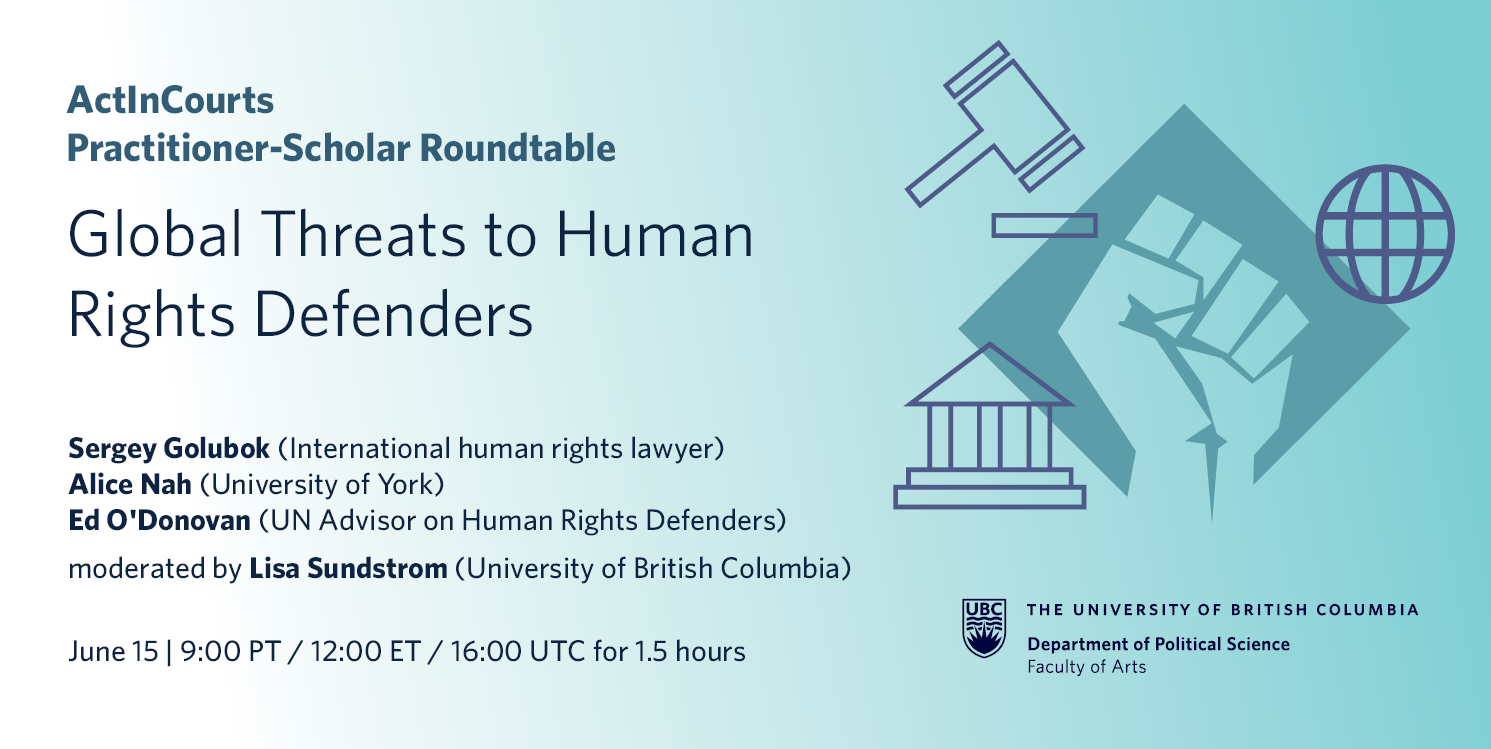
On June 15, we led a virtual discussion on a range of threats to the safety and the work of human rights defenders, particularly those active in cases at international human rights tribunals, and strategies to help protect and support them.
Speakers
- Dr. Sergey Golubok is a lawyer who has represented clients in civil rights cases before the courts of the Russian Federation, including the Supreme Court and the Constitutional Court, as well as before international institutions such as the European Court of Human Rights and United Nations treaty bodies in Geneva. He is admitted to practice as counsel before the International Criminal Court where he has advised a protected witness. Dr Golubok is a senior expert with the Netherlands Helsinki Committee in The Hague.
- Dr. Alice Nah is a Senior Lecturer at the Centre for Applied Human Rights, University of York. She conducts research on the security and protection of human rights defenders at risk, and on asylum and migration in Asia. She is also currently Chair of the Board of Protection International and of the International Detention Coalition. Her book Protecting Human Rights Defenders at Risk (Routledge, 2020) assesses the construction, operation and effects of the international protection regime for human rights defenders and sets out proposals for the way that protection should be reimagined and practiced.
- Ed O’Donovan is currently Special Advisor at the UN Special Rapporteur on Human Rights Defenders, as well as a Guest Researcher at the Norwegian Centre for Human Rights. Previously, he was Head of Protection and a Protection Coordinator for East Asia at Front Line Defenders.
- Lisa Sundstrom (moderator) is Principal Investigator of the ActInCourts Network, and Professor of Political Science at the University of British Columbia.
If you missed the event, you can watch a recording on Zoom. Passcode: G9A&UQL!
Prosecuting Ecocide: Q&A with Dr. Stavros Pantazopoulos
On Wednesday, January 19, Activists in International Courts hosted a virtual panel discussing a recent proposal to add ecocide as the Fifth International Crime.
The panel, chaired by UBC Political Science Professor Lisa Sundstrom, discussed the challenges of defining and prosecuting ecocide, how to fight against impunity of environmental crimes in practice, and the limitations of the proposed definition.
The event was moderated by Dr. Stavros Pantazopoulos, a post-doctoral researcher with the Toxic Crimes Project of the Erik Castrén Institute at the University of Helsinki and a Co-Chair of the Law Interest Group of the Environmental Peacebuilding Association. We spoke to Dr. Pantazopoulos about what the event means for Activists in International Courts.
In June 2021, a new definition was proposed by the Stop Ecocide Foundation that labeled ecocide an international crime. Who has been involved in this proposal and what are the next steps for them?
Taking into account the growing momentum of criminalizing the mass damage and destruction of ecosystems, interested parliamentarians from governing parties in Sweden requested the Stop Ecocide Foundation to propose a legal definition of ‘Ecocide’. Following this request, the Stop Ecocide Foundation convened an Independent Expert Panel in November 2020, which was composed of twelve prominent international lawyers, including two of our panelists. The Panel was assisted by outside experts and a public consultation that brought together hundreds of ideas from legal, economic, political, youth, faith, and indigenous perspectives from around the globe. A consensus on a core text of a definition of ‘ecocide’ as an international crime was reached in June 2021.
The objective for the proposed definition is to serve as the basis for amending the Statute of the International Criminal Court (ICC), so that the crime of ecocide becomes the fifth international crime of the ICC Statute, sitting along the other four international crimes proscribed in it, namely genocide, crimes against humanity, war crimes, and aggression.
What are some of the benefits and challenges to creating a definition of Ecocide as the Fifth International Crime? What insights do your panelists bring to this discussion?
On a symbolic level, defining and criminalizing ‘Ecocide’ could send shockwaves through the international community. This is a strong message that the causation of massive environmental harm will not go unpunished. Moreover, the inclusion of ‘ecocide’ in the ICC Statute may serve as an effective deterrent and further ensure that appropriate reparations for environmental harms are granted. But this is only one side of the story.
To name a few challenges, as our panelists have already argued, a proposal to amend the ICC Statute to incorporate the international crime of ‘Ecocide’ may face procedural hurdles, such as the failure to gain the required majorities of State Parties for inclusion or temporal jurisdiction limitations (principle of non-retroactivity) if ecocide eventually becomes the fifth international crime of the ICC Statute.
What are you looking forward to from the discussion at ActInCourts upcoming workshop?
Given the diverse background of our speakers, we are confident that the ensuing discussion will highlight the untapped potential of combining theoretical with practical insights. Our discussion will showcase the advantages and the attendant risks of defining and criminalizing ‘ecocide’. In addition, our Roundtable will help us identify not only the entry points in the international legal and judicial architecture, so as to pursue claims of mass environmental destruction, but also the blind spots of such a definition.
How would this new definition impact the work of Activists in International Courts?
We truly hope that the newly proposed definition of ‘ecocide’ will open up novel opportunities to rights advocates for prosecuting the commission of environmental wrongdoing. Our network, Activists in International Courts (ActInCourts), is interested in expanding our understanding of international rights advocacy to new types of rights emerging on the frontiers of international jurisprudence. In fact, such a definition carries the potential to inform the work of ActInCourts and turn into a guide and a source of inspiration for future endeavours. Rights advocates can already use this definition when pursuing environmental claims before international courts and tribunals so that it becomes firmly grounded in existing institutional practices. If this definition is taken up by international judicial bodies, it will be further bolstered and thus serve as the reference point when prosecuting environmental wrongdoing.
If you missed the event, you can watch a recording on Zoom. Passcode: ZU9R0*mF
Can we fill the Accountability Gap for Environmental Harm?
On Wednesday, January 19th, 2022, we led our fifth installment of our Practitioner-Scholar Roundtable. Since the inception of the idea to define and criminalize environmental harm in the 1970s, today there is a renewed momentum and support to address accountability for environmental harm. In June 2021, an Independent Expert Panel for the Legal Definition of Ecocide (‘Panel’), convened by the Stop Ecocide Foundation, proposed a new definition of ecocide as an international crime. Having received both positive and critical responses, this renewed effort might initiate a process to amend the Rome Statute of the International Criminal Court (ICC) with Ecocide becoming the Fifth International Crime.
The virtual panel discussed the challenges of defining and prosecuting ecocide, how to fight against impunity of environmental crimes in practice, and the limitations of the proposed definition. The discussion was led by:
- Rachel Killean is a Senior Lecturer in the Queen’s University Belfast School of Law and a Fellow of the Senator George J. Mitchell Institute for Peace, Security, and Social Justice.
- Richard Rogers is a Partner at Global Diligence and a Deputy Co-Chair of the Independent Expert Panel for the Legal Definition of Ecocide
- Alex Whiting is a Deputy Prosecutor of the Kosovo Specialist Prosecutor’s Office in The Hague and a Visiting Professor of Practice at Harvard Law School. Alex was a member of the Expert Panel that proposed a definition of the crime of Ecocide
- Maud Sarliève is a Human Rights and International Criminal Lawyer advocating for creative legal thinking to mitigate climate change and protect the environment
- Stavros Pantazopoulos (Moderator) is a post-doctoral researcher with the Toxic Crimes Project of the Erik Castrén Institute at the University of Helsinki and a Co-Chair of the Law Interest Group of the Environmental Peacebuilding Association
- Lisa Sundstrom (Chair) is a Professor of Political Science at the University of British Columbia
If you missed the event, you can watch a recording on Zoom. Passcode: ZU9R0*mF
Does Facebook’s Oversight Board Promote International Human Rights?
On Thursday, October 28th, 2021, we led our fourth installment of our Practitioner-Scholar Roundtable. The Oversight Board is one of the most significant innovations in global human rights governance, affecting freedom of expression and other rights for over 2.5 billion users. Facebook created the Board to provide independent review of its decisions and policies regarding content on Facebook and Instagram. Since its launch in early 2021, the Board has issued decisions ranging from the suspension of President Trump’s Facebook account to the removal of hateful content in France, Myanmar, Colombia and South Africa. It has frequently overturned Facebook’s decisions and issued policy recommendations.
This panel will discuss whether and how the Oversight Board adds to the international human rights architecture, undermines it, or does something quite different. The discussion will be led by:
- Jamal Greene is the Dwight Professor of Law at Columbia University and co-chair of the Oversight Board
- Vivek Krishnamurthy is the Professor of Law at the University of Ottawa and Director of the Samuelson-Glushko Canadian Internet Policy and Public Interest Clinic (CIPPIC)
- Wendy H. Wong is Professor of Political Science and Canada Research Chair in Global Governance and Civil Society at the University of Toronto
- Chris Tenove (Moderator) is ActInCourts Coordinator and postdoctoral fellow in Political Science, University of British Columbia
- Lisa Sundstrom (Chair) is Principal Investigator of the ActInCourts Network, and Professor of Political Science, University of British Columbia
If you missed the event, you can watch a recording on Zoom.
Dilek Kurban on Kurdish Rights Activism and the Limits of Supranational Justice
This Q&A was conducted and edited for clarity by Alexandra Yao.
We spoke with Dr. Dilek Kurban about her new book, Limits of Supranational Justice: The European Court of Human Rights and Turkey’s Kurdish Conflict, published by Cambridge University Press in October 2020. Dr. Kurban is a Max Weber post-doctoral fellow at the European University Institute, specializing in supranational human rights courts and legal mobilization. Her book analyzes the European Court of Human Rights’ (ECtHR) engagement in Turkey’s Kurdish conflict since the early 1990s, and demonstrates the need to reassess current academic and jurisprudential approaches to studying the effectiveness of supranational human rights courts in authoritarian regimes.
How did you become interested in this topic?
It was a combination of chance encounter and personal background. In the summer of 1998, when I was pursuing a master’s in human rights at Columbia University, I spent a few weeks in Turkey’s Kurdish region as part of a fact-finding mission by Fordham Law School. I was assisting American lawyers and law students in their fieldwork on the right to fair trial under Turkey’s state security court system. It was there and then that I met Kurdish human rights lawyers for the first time. The Kurdish region was governed by an emergency regime, the civil war between the Turkish military and the PKK was in full force, egregious human rights abuses such as the enforced disappearances, torture and extrajudicial executions of Kurdish civilians were routine affairs, and yet these small group of women and men were seeking justice all the way in Strasbourg. Their extraordinary courage, resilience, and creativity in mobilizing the European Court of Human Rights (ECtHR) against a state engaged in systematic violence was a life-changing experience for me. I carried their story with me for two decades. I built strong professional and personal relations with the Kurdish lawyers I met in 1998 and many more, particularly during the decade I spent back in Turkey, when I engaged in policy-oriented research during the short-lived democratization process. I worked very closely with them in various capacities- interviewing them, this time for my own research, collaborating with them in joint advocacy and policy projects, engaging in participatory observations and, of course, building lasting friendships with them. When I once again left Turkey in late 2012, I finally found the time, energy, mental and physical distance to tell the story of this remarkable case of legal mobilization against an authoritarian regime engaged in state violence.
And then there is the personal element. I, myself, am Kurdish. Although I was born and raised in Istanbul, I was aware of the oppression, marginalization and discrimination of Kurds living in the Kurdish region thanks to the summer holidays I spent in our ancestral village where we visited my grandparents. Thus, from a very young age, I was vividly aware of the law’s false promises of equality, justice and liberty for all.
What is the overarching argument of your book?
That we need to assess the effectiveness of supranational human rights courts through their performance where they are most needed – protecting minorities against state violence by authoritarian regimes – and not in liberal democracies, where conventional scholarship has tended to focus.
What are the core lessons you are hoping readers will take away from your book?
That context matters. Law does not operate in a vacuum and the political context is highly determinative of the ability of human rights to meet its basic promises. It is imperative for supranational courts to take into consideration the domestic circumstances in which human rights violations occur and to adjust their adjudication accordingly. The ECtHR’s engagement in Turkey’s Kurdish conflict is a powerful case demonstrating the pitfalls and, indeed, real dangers of rigidity in supranational adjudication. Supranational courts must be mindful of the historical and political context surrounding the cases they adjudicate and adjust their procedural rules and substantive doctrines accordingly. Where domestic courts are unable or unwilling to hold power into account, it is the moral obligation and legal duty of supranational courts to step in. Otherwise, the rigid application of the principle of subsidiarity leaves millions of victims of state violence without any judicial protection.
What new avenues of research do you see your book opening up?
Just as supranational adjudication needs to differentiate between authoritarian regimes and liberal democracies, so does scholarship. We do not have a theory on the effectiveness of human rights courts in authoritarian settings. Similarly, legal mobilization scholarship needs to put forth an empirically grounded theoretical framework of the particular difficulties of supranational legal action against authoritarian regimes, where domestic courts are complicit in state violence and domestic lawyers mobilize at great personal risks. We also need more in-depth, contextualized, socio-legal research on the interaction between global and local law in authoritarian contexts. Finally, doctrinal legal scholars have been focused too much on judgments when assessing the effectiveness of supranational courts. In the ECtHR context, the cases which resulted in a ruling are a tiny fraction of those that were petitioned. Nearly 95% of the cases result in inadmissibility decisions. And then there are those that result in ‘friendly settlements’, where applicants have been practically compelled to settle their claims with their governments or else risk their applications to be struck out of the list. Fortunately, more attention is being paid to those stories, but theoretical scholarship has not yet caught up.
What are common misconceptions about Kurdish legal mobilization that your book addresses/clarifies?
That Kurdish legal mobilization has been possible with the involvement of British human rights lawyers through the brokerage of a London-based transnational advocacy network. That it was a success story in that it resulted in pioneering and precedent-setting ECtHR judgments. And that the ECtHR was receptive to it. In reality, Kurdish legal mobilization did not start with the involvement of transnational actors; neither did it end with the departure of British lawyers who moved on to work on the Russian cases. While the Kurds did indeed win very strong judgments against the Turkish state, which documented the nature and scale of state violence in the Kurdish region, they were not entirely successful. Even during the ‘Golden Age’ of its involvement in the Kurdish cases, the ECtHR never ruled that torture, extrajudicial executions, forced displacement and enforced disappearances were systematic or that they were a matter of government policy. After dozens of nearly identical rulings finding Turkey to have engaged in these practices, the ECtHR never accepted Kurdish lawyers’ argument that these violations were the product of government policy. Finally, the ECtHR has become increasingly less receptive to Kurdish legal mobilization. Preoccupied with its workload, it became prone to collaborating with the Turkish government by effectively rubber stamping the new domestic remedies the latter had adopted to decrease the number of adverse judgments as well as new applications.
What implications does this have for the public perception or legitimacy of ECtHR jurisprudence?
The Kurds in Turkey were once among the most vocal and passionate advocates of the ECtHR. Kurdish civilians and their lawyers had a strong belief in the impartiality of the Strasbourg court and its effectiveness, notwithstanding its unwillingness to make full use of its adjudicatory tools and resources vis-à-vis Turkey. This drastically changed in the mid-2000s with a critical inadmissibility decision issued in 2006 where the ECtHR declared Turkey’s new compensation law to be an effective domestic remedy that the displaced Kurds had to exhaust before petitioning Strasbourg. In doing so, the ECtHR not only hastily endorsed a law which had just been adopted and barely started to be implemented, but went against its own jurisprudence in the Kurdish cases where it said over and over again that a domestic remedy which provides compensation without justice cannot be effective. The erosion of public trust and respect for the ECtHR has become a more widespread phenomenon in Turkish society more broadly after the failed coup attempt in July 2016. Tens of thousands of civil servants (including judges and prosecutors, among them two members of Turkey’s Constitutional Court) who have been purged from their jobs, arrested, held in prolonged pre-trial detention, banned from leaving the country on dubious terrorism charges and without any due process, have been denied review in Strasbourg. Effectively reversing the basic premise of supranational judicial review, the ECtHR has been following the lead of Turkey’s Constitutional Court and rubber stamping its inadmissibility decisions in the name of subsidiarity. As a result, a very significant segment of the public in Turkey now shares the Kurds’ perception of the ECtHR as a politicized institution engaged in behind-the-doors bargains with an authoritarian regime.
Are there potential mechanisms available to address/accommodate the limits of supranational justice?
Yes, I believe so. The real question in analyzing the effectiveness of a supranational court in authoritarian settings is what consequences its involvement has had. And I am not referring to legal consequences. The toolbox of authoritarianism includes making cosmetic legal changes to give the appearance of compliance while engaging in similar violations. What truly matters are political and social consequences. Certainly, there is no guarantee that authoritarian regimes will crack under pressure. In fact, more often than not, they don’t. Therefore, it would be naïve to expect supranational courts to change the behavior of authoritarian regimes. The best, and arguably only, outcome they can strive for is to empower domestic human rights groups in their non-violent resistance to government repression. For that, I argue, we need to re-define effectiveness.
When authoritarian regimes are engaged in state violence against their minorities, we need to understand effectiveness as having two interrelated dimensions: supranational courts’ full use of their adjudicatory tools and doctrines in overseeing state violence (top-down) and responsiveness to the mobilization of domestic human rights communities against such violence (bottom-up). These dimensions are independent of supranational courts’ ability to change state practice, but concern their willingness to exhaust their jurisprudential powers for documenting state violence, ordering remedies capable of bringing real policy change and being (and remaining) open to victims’ justiciable claims by demonstrating flexibility on matters of admissibility and evidence.
In applying their procedural rules such as admissibility, evidentiary standards and burden of proof, and substantive doctrines such as margin of appreciation, it is absolutely imperative for supranational courts to differentiate between liberal democracies and authoritarian regimes. They need to be mindful of the fact that in the latter, individuals have no judicial protection against state oppression and violence and that they need to step in to fill that justice gap.
What implications does your study of Kurdish human rights advocacy, and its limits, have for other advocacy efforts at the ECtHR or even at other international courts (e.g. Inter-American or African systems)?
The ECtHR’s engagement in the Kurdish cases is just one case in a broader picture. It is representative of a larger phenomenon- supranational adjudication of authoritarian regimes engaged in gross and systematic violations against minorities. My conclusions have implications for the ECtHR’s engagement in other similar cases (e.g. the Chechen cases against Russia) and indeed for other supranational courts dealing with similar questions. In my current research project, I am undertaking a comparative study of the European and inter-American human rights regimes in terms of their oversight of authoritarian regimes engaged in legal repression and state violence against minorities. We need more in-depth, country-specific empirical research as well as comparative empirical research – between countries, violations and regional regimes.
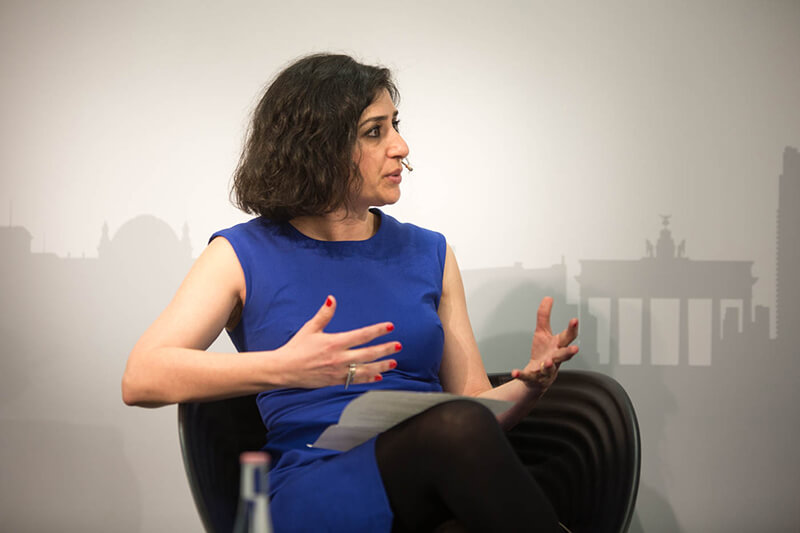
Above Image: Dilek Kurban speaks at an event at the Hertie School. (Hertie School)
